:
Do-It-Yourselfers & Contractors -
Learn from the solar water heaters industry leader
If you're new here at Alternative Energy HQ, you may want to subscribe to our RSS feed for all the latest updates on energy news. Thanks for visiting!
Of the fossil fuels, natural gas is the cleanest source of energy to use for many of our every day needs and activities. It plays an important part in reducing pollution so that a clean and healthy environment can be maintained. Because of its almost perfect combustion process, very few byproducts are emitted into the atmosphere as pollutants. The environmentally friendly attributes of natural gas reduce air pollution.
Composed primarily of methane, the main products of the combustion of natural gas are carbon dioxide and water vapor which are the same compounds we exhale when we breathe. Unlike other fossil fuels, the combustion of natural gas releases very small amounts of sulfur dioxide and nitrogen oxides, virtually no ash or particulate matter, and low levels of carbon dioxide, carbon monoxide, and other reactive hydrocarbons.
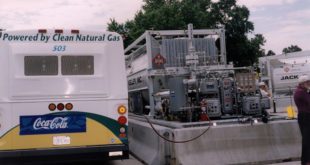
Transportation vehicles such as automobiles, trucks, and buses contribute greatly to the air pollution in the United States. This kind of air pollution makes for low visibility, smog, and various greenhouse gas emissions. According to the Department of Energy (DOE), more than 80 percent of air pollution in cities is produced by transportation vehicles. Natural gas can be used to cut down on these high levels of pollution from gasoline and diesel powered cars, trucks, and buses.
According to the EPA, vehicles operating on compressed natural gas have reductions in carbon monoxide emissions of up to 97 percent and reductions in carbon dioxide emissions of 25 percent. Nitrogen oxide emissions, and other non-methane hydrocarbon emissions could all be reduced drastically. Because of the relatively simple makeup of natural gas, there are fewer toxic and carcinogenic emissions from vehicles running on natural gas.
More: continued here
Energy Tags: natural gas

The following article exposes how much of a problem CO2 emissions have become in the UK. The factors that contribute to the problem have been highlighted, along with methods that can be taken to help overcome them.
As the majority of the population is aware, there is no longer any reasonable doubt that the dramatic climate change the world is experiencing is down to carbon dioxide or CO2 emissions and its abundance within our environment. What you may not know however, is just how much the UK contributes to this world wide dilemma.
With only 1% of the world’s population, the UK still manages to emit 2.3% of the worlds CO2! Although this figure is an improvement on past years, (this largely being to do with the switch from coal to gas for energy), there is still a lot more that could, and should, be done.
The bulk of the change needs to be made by the people of the UK, as in 2004, the average household emitted around 6 tonnes of CO2; which is the equivalent to 34 double-decker buses! This is due to the burning of fossil fuels in the energy stations used to supply energy to our homes. Along with emitting the most CO2, such energy sources are generally hazardous and unreliable; this is why they are referred to as ‘non-renewable sources’. Some of these sources may be exhausted within the next 70 years. Although this sounds like an alarming prospect, the solution is simple – to generate energy without creating CO2.
More: continued here
The government is on a mission to improve the UK's energy security and reduce carbon emissions. Almost 40% of the UK's energy is used in the heating, lighting and operation of our homes. With 25 million homes in the UK, even small improvements across the market can have a significant overall impact.
More: continued here
energy used in homes is responsible for more than a quarter of the UK's carbon emissions, and about 80 per cent of the energy we use is for heating.
This is why turning down your thermostat, having good insulation and more efficient boilers can help tackle climate change, reduce air pollution, cut fuel bills and can add value to your home.
Despite this, it is troubling to think that the majority of pensioners still pay over the odds to their gas suppliers.
Yet with the right information and guidance, there are many ways to lower payments and use the extra money saved for more important things in life.
For example, by saving or investing in products that help to insulate the home, over the long run the money you save on the gas bill will pay back the outlay on keeping your home warmer.
Of course, one question many pensioners will be asking is that of where to find the money needed to carry out those improvements.
More: Cheaper Gas For The Winter continued here
Found an interesting post on a Oil and Gas industry blog today discussing the merits of [tag-tec]natural gas [/tag-tec]and whether it is "green" or not.
Here is a quote from that blog:
Natural gas has recently made it into the spotlight, and for good reason: it’s clean burning. And in this post-industrialist era, that’s more than important. Green energy is a term for environmentally friendly, renewable sources of power and energy. Although natural gas doesn’t quite fit the definition of [tag-ice]green energy[/tag-ice] (it is a finite resource and produces some carbon dioxide), it has recently garnered significant U.S. attention. According to the U.S. Energy Information Administration, “Natural gas burns more cleanly than other fossil fuels. It has fewer emissions of sulfur, carbon, and nitrogen than coal or oil, and it has almost no ash particles left after burning. Being a clean fuel is one reason that the use of natural gas, especially for electricity generation, has grown so much and is expected to grow even more in the future.”
While it is certainly true that natural gas is cleaner than many other forms of traditional fuels that run our world it is not without its own problems. It is coming from the same sources as our oil supplies. it has to be extracted and shipped. This can be expensive, cause pollution of its own, and like oil the natural gas we rely on could run out in time. It is just a cleaner version of oil that makes the big industry a tidy profit but which has limited supplies over the course of time.
While we should encourage use of it in the world we cannot allow ourselves to be fooled into thinking natural gas is a our alternative fuel supply forever.