April 11, 2011
Texas Football Stadium To Get Wind Power
Wind turbines to generate power for new UNT football stadium
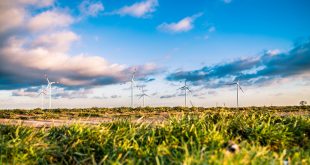
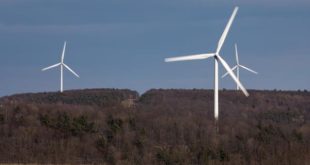
DENTON (UNT), Texas , The University of North Texas has received a $2 million grant from the State Energy Conservation Office to install three wind turbines that will feed the electrical grid that provides power to UNT’s new football stadium and other buildings on the west side of Interstate 35E.
The stadium, which will open in September, is the first collegiate stadium designed to incorporate onsite renewable energy. The turbines are expected to be installed by the end of the year.
“The effort by the staff of the UNT System and the university to meet the requirements of the Department of Energy and the State Energy Conservation Office to win the grant for these new turbines underscores our commitment to creating a carbon-neutral campus,” said V. Lane Rawlins, president of UNT. “Our university has a 50-year legacy of environmental research and sustainability and we’re proud to be the first university in Texas to install wind turbines on campus. “
It is estimated that the three wind turbines will offset the energy consumption of Mean Green Village, the area of campus surrounding the new stadium, by about 6 percent and eliminate 323 metric tons of carbon dioxide being emitted annually. The turbines will be visible from I-35E and I-35W providing visual evidence of UNT’s commitment to sustainability.
A web-based monitoring system will provide details on energy production, carbon reduction statistics and empirical data that can be used for both educational and research purposes at UNT. Designed for low wind conditions, the community-scale 100kW wind turbines are well suited for the North Texas region, which has a wind speed average of approximately 12 mph.
Unlike the very large turbines generally found at wind farms, community-scale turbines are considerably smaller and ideal for municipalities, schools, neighborhoods, and universities. The approximate noise level of the turbines is 55 decibels at 40 meters (131 feet), which is equivalent to that of a normal conversation between two people.
“The construction of wind turbines at UNT will be an invaluable asset to the university and surrounding communities,” said Richard Escalante, vice chancellor for administrative services. “The reduction in carbon emissions from the use of fossil fuels will be a collective benefit for the entire North Texas region. Sustainable initiatives, such as the use of renewable energy technologies, ensure that future generations of the UNT and Denton communities are equipped with the necessary tools to continue economic expansion while simultaneously protecting the environment and human health.”
The wind turbines will be located southwest of the new stadium, and aligned approximately parallel to Bonnie Brae Street. The turbines will be on the east side of Bonnie Brae.
Design and construction of the turbines is expected to begin immediately. At its November meeting, the UNT System Board of Regents selected HKS DesignGreen for the design of the turbines and supporting structure. The construction manager will be selected shortly, according to Raynard Kearbey, UNT System associate vice chancellor for system facilities, whose team is overseeing design and construction of the stadium and wind turbines.
“These wind turbines will give UNT a trifecta of benefits,” noted Chris Mundell, sustainable design manager with HKS DesignGreen. “They will be an innovative educational tool for UNT students and faculty. The turbines also will be a symbol of sustainability for all the stadium’s spectators. Lastly, they help offset energy consumption of the new stadium, making it one of the most energy efficient in the country.”
The new stadium, which will replace 57-year-old Fouts Field, is designed by award-winning architects HKS Sports & Entertainment Group (www.hksinc.com), the firm that designed the new Dallas Cowboys stadium. The UNT System will be seeking LEED Gold or Platinum certification. If the project is awarded LEED Platinum, it will be the first of its type to achieve this rating in the country.
Filed under Wind Power by newenergy
December 16, 2010
Can Wind Turbines Help Crops?
Researchers at the Ames Laboratory and the University of Colorado find that wind turbines help channel beneficial breezes over nearby plants
AMES, Iowa – Wind turbines in Midwestern farm fields may be doing more than churning out electricity. The giant turbine blades that generate renewable energy might also help corn and soybean crops stay cooler and dryer, help them fend off fungal infestations and improve their ability to extract growth-enhancing carbon dioxide [CO2] from the air and soil.Speaking at the annual meeting of the American Geophysical Union, a scientific society, in San Francisco today, a researcher at the U.S. Department of Energy’s Ames Laboratory and his co-researcher from the University of Colorado announced the preliminary findings of a months-long research program aimed at studying how wind turbines on farmlands interact with surrounding crops.
“We’ve finished the first phase of our research, and we’re confident that wind turbines do produce measureable effects on the microclimate near crops,” said Ames Laboratory associate and agricultural meteorology expert Gene Takle. According to Takle, who is also a professor of agricultural meteorology and director of the Climate Science Program at Iowa State University, the slow-moving turbine blades that have become a familiar sight along Midwestern highways, channel air downwards, in effect bathing the crops below via the increased airflow they create.
His colleague in the research is Julie Lundquist, assistant professor, Department of Atmospheric and Oceanic Sciences, at the University of Colorado at Boulder, joint appointee at the U.S. Department of Energy’s National Renewable Energy Laboratory, and Fellow of the Renewable and Sustainable Energy Institute. Lundquist’s team uses a specialized laser known as a lidar to measure winds and turbulence from near the Earth’s surface to well above the top tip of a turbine blade.
More on Can Wind Turbines Help Crops?
Filed under Press Releases, Wind Power by newenergy
September 23, 2010
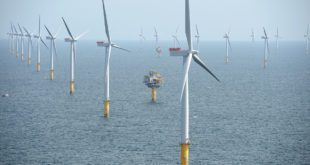
Largest Wind Farm Powers Up Off England Coast
The world’s largest offshore windfarm, partially built by a Norfolk firm, was officially opened off the UK coast yesterday.
The Thanet offshore windfarm, off the south east coast of England, has 100 turbines which will produce enough green energy a year to power the equivalent of more than 200,000 homes.
The project was completed by energy company Vattenfall and the turbines were installed with the help of Great Yarmouth-based engineering firm CLS Offshore, an EDP Business Awards finalist.
The total capacity of the UK’s onshore and offshore wind turbines now exceeds 5 gigawatts, enough to power all the homes in Scotland.
CLS installed part of the turbines, helping slash installation times from 24 hours to five-and-a-half hours while delivering a perfect safety record.
Filed under Wind Power by newenergy
To find out how wind energy work, one must be familiar first with what it is. It basically comes from the sun, and about one to two percent of this solar energy is converted to wind energy. When the sun’s reflected rays are absorbed by water or land, this causes the atmosphere to become warm. Because hot air is lighter than cold air, it will rise up. When hot air rises until it is approximately six miles in altitude and as the cool air replaces this in the atmosphere, wind energy is formed. Although it is more commonly known as a converted form of solar energy, it is also recognized for its property of converting kinetic energy into both electrical and mechanical energy.
The converted forms of energy, which are electrical and mechanical energy, are used by mankind for a multitude of purposes. On main element to consider in knowing how wind power work is its turbine. With the use of its propeller blades, wind turbines supply power to whatever mechanical generator there is that will convert wind energy to electricity. The power generated by one wind turbine is believed to be enough to run electricity in one house. A propeller blade is actually a mechanical rotor that is assembled in threes, with the blades connected at the center. The more wind there is, the more these blades are propelled by the wind, and the more electricity is produced. Most of the time, the electricity generated from the wind turbines are fed directly into power lines. This electricity is then combined with other forms of electricity coming from other sources and it becomes the utility electricity that is being delivered to households.
Another important factor is its environmental benefits. It is said to be more practical and eco-friendly because it does not pollute the environment with green house gases that are emitted by fossil fuels when they produce electricity. Also, it is abundant and renewable. Apart from being pollution-free, it is relatively very cheap. It is used by a lot of households in generating electricity. It has been studied that for every one megawatt of wind energy, about two hundred twenty five to three hundred households receive electricity from the said amount of wind power. It comes from solar energy. It is safe to say then, that the sun truly has so much power that if mankind only knew how to properly utilize these energies coming from the sun, there would be less and less dilemmas on where to get electricity.
Filed under Wind Power by newenergy
There’s power in the wind!
With today’s high power cost and worsening environmental problems, people resort to wind power because of its cost-effective and environment-friendly feature. Although it has been in existence for a long time, not many people possess a great deal of knowledge about this useful alternative in power generation.
That’s the very thing that prompted the men and women behind www.windturbines.net. As a social network for the wind turbine community, it aims primarily to deliver fresh and valuable information to interested parties in the growing field of renewable wind energy. This website is on its way toward the achievement of its vision of gathering the big names who have shared passions for the environment, science and technology.
Windturbines.net features a directory of wind energy information sources – manufacturers, consultants, associations, installers, landowners, utility companies, developers, governments, investors, technicians, and wind farm operators. This is a portal to all those who seek information and contact to experts in wind technology around the globe. As it aims to keep this directory growing, the site allows members to add an entry and link it to their site.
Providing general information about wind turbines and wind power technology is also a good thing about this site. Through its wiki page, you can access, edit or add useful information about this renewable energy source. By sharing your knowledge with wind turbine enthusiasts, you enrich people’s knowledge of the benefits, drawbacks, and the future of wind technology.
The community page is another awesome feature of the site. This is where you can find people to share your opinions and thoughts with. When you become a member of this world’s first wind energy social networking site, you’ll get the chance to discuss related stuff with other people who share the same interest with you. This is open to everyone, from people who are just interested in wind turbines to large scale wind farm developers.
If you’re looking for information about wind power, visit and explore windturbines.net. Start expanding your network with the people in the site by sharing your knowledge and opinions on this ever growing industry. By simply doing that, you are helping in the promotion of an energy source that is not only helpful in lowering consumers’ power consumption expenses but also in providing the world with a clean and green power generation.
Filed under Wind Power by newenergy
September 22, 2008
Making Wind And Solar Power A Breeze
With the advent of solar and wind power consumers are changing the way they look at powering their homes. Instead of using polluting fossil fuels, many environmentally conscious people are turning to these clean and renewable energy sources to power their homes and businesses. In this article, we’ll detail how wind and solar energy works and how these systems can save you money.
By converting kinetic energy into mechanical power wind turbines it can then run a generator to produce clean electricity. There are several things that you should keep in mind if you intend to invest in wind and solar energy. Firstly, your property must have a good wind resource and you will have to check with your local government to make sure that tall towers are allowed in your area.
It is a fact that wind energy systems are one of the most cost-effective method for home-based renewable energy . Depending on your wind resources, a small wind energy system can lower your electricity bill by 50% to 90% and help you avoid the high costs of having utility power lines extended to remote locations, prevent power interruptions and pollution.
Filed under Alternative Energy by newenergy
August 27, 2008
Solar Energy (pakistan Base)
“SOLAR ENERGYâ€
Â
Today in Pakistan we are facing shortage of almost every basic need of life like water, gas, and especially electricity. It is the worst conditions we are facing now a days. The reason for that is…well we all know “THE REASONS†don’t we!!! Few days back I was reading an article in a local newspaper which was about getting electricity like many European countries which is from “Wind Turbinesâ€. It’s a very good idea and we must have to think other ways of energy to meet our needs. Another idea which I’m going to discuss here is “SOLAR ENERGYâ€.  As we all know that summer season is longer than winter in Pakistan. So it means we can get more and more sunlight. In my view Solar Energy Systems will be more successful in Pakistan than any European country because thankfully we can have more sunlight than Europe.
Many scientists and engineers from all over the world are working in this field. Some say that it’ll be very costly, YES it’ll be but only in start as like everything when it’s new its price is high but when the competition arises then prices goes down its simple economics. We’ve used the Sun for drying clothes and food for thousands of years, but only recently have we been able to use it for generating power. The Sun is 150 million Kilometers away, and amazingly powerful. Just the tiny fraction of the Sun’s energy that hits the Earth (around a hundredth of a millionth of a percent) is enough to meet all our power needs many times over. In fact, every minute, enough energy arrives at the Earth to meet our demands for a whole year – if only we could harness it properly and preserve it.
Filed under Alternative Energy by newenergy
February 6, 2008
Getting More Energy From The Wind
Over the past couple of decades, we’ve seen an increasing demand for alternate forms of energy. This demand has led to the proliferation of wind farms across North America. It really is hard not to be optimistic about the potential benefits wind energy can provide. However, with the increasing cost of manufacturing and the lack of investment in technology we often find our progress stinted with less than expected results.
Many people see wind energy as the way of the future, but little fully understand how it will become part of our energy mix.
I’ve recently had the opportunity to collect some preliminary data regarding the efficiency of wind turbines. This data is being used to determine how Power Factor is related to wind turbines and how we can improve the amount of energy they generate. This data has shown us that wind turbines are actually quite inefficient. In fact, large scale turbines are producing only about 30-35% of the energy they are rated for at the best of times.
More on Getting More Energy From The Wind
Filed under Wind Power by newenergy