If you're new here at Alternative Energy HQ, you may want to subscribe to our RSS feed for all the latest updates on energy news. Thanks for visiting!
Would you like to listen to the keynote speech by General Motors’ Larry Burns in which he makes a call for a vast expansion of hydrogen stations to fuel the current and future generations of fuel cell vehicles? As a result of recent studies completed with Shell Hydrogen, he stated with confidence that a hydrogen fueling infrastructure is less challenging and less costly than many people think.
Last month, the National Hydrogen Association wrapped up its Annual Conference and Hydrogen Expo, held this year in Sacramento, California.
H2Gen’s Sandy Thomas presented the findings of a comprehensive, life cycle analysis of hybrid, plug-in, ethanol and hydrogen vehicles showing that while all of these fuel and technology pathways should be pursued for near-term benefits.
Will be used to fuel SMUD hydrogen fuel-cell vehicles as well as others in the region
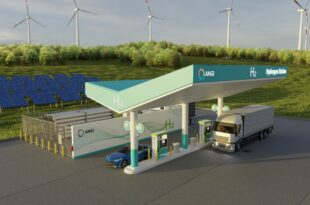
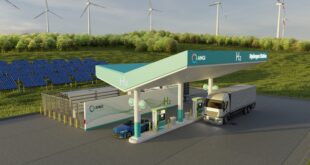
The Sacramento Municipal Utility District (SMUD) is taking a bold step into the future of
automotive technology. Earlier this month SMUD formally opened a solar-powered hydrogen fueling
station for fuel-cell electric vehicles (FCEV).
The station is part of a joint SMUD, BP, Ford and U.S. Department of Energy project to
demonstrate FCEVs and generation of hydrogen from renewable sources. The station produces hydrogen
onsite using power from the sun produced by a large solar panel array. The hydrogen will be used to fuel
SMUD FCEVs and other hydrogen-powered vehicles in the region. The project is the next step in a
nearly two-decade-long effort by SMUD to improve local air quality by advancing alternative-fuel clean
transportation, as well as cleaner power sources.
Wow have you seen this car? The Aptura is scheduled to launch sales later this year in California. An electric (or plug in hybrid) vehicle that also looks very cool. Now we are talking.
The first Operating Prototype achieved over 230 Miles per gallon!
Five years ago, Aptera's founder Steve Fambro endeavored to design and build a passenger vehicle that was safe, comfortable, and more fuel-efficient than anything ever produced. This aspiration, combined with his background in engineering, led him to an intensive study of aerodynamics, and composite aircraft construction. He hypothesized that a low-drag, aerodynamic body shape could be achieved without sacrificing comfort, drivability or safety.
What emerged, after much designing, conceptualizing, and constructing, was a prototype two-seat, three-wheeled vehicle. This first operating prototype achieved a stunning 230 miles per gallon, Building on this success, Steve expanded his Aptera team and created the Aptera Typ-1, which has been re-designed, re-engineered, and refined into a production ready vehicle. We are excited to announce that the Aptera Typ-1 is now available for reservations.
A little preview of the Aptura from the LA Times:
Say hello to papa, I want on of these cars. Sign me up.
Ethanol It was a good alternative. Then it was not, then it was. Now it is a raging debate with charges flying all about.
Now we have rising corn prices (read- consumer food prices) and an adminstration that is locking in support of ethonal while the community debates the merits. What do you think? Here are some videos on the subject to stimulate your thoughts.
What do you think of ethanol? Shout out and let us know.
Snippy well produced video full of info about the green energy world.
Check it out.
Here is the rundown on Zaproot from the ViroPop website:
Okay, let’s get this straight. ViroPop is NOT a new virus-flavored soda. And ZapRoot is not a show about bombarding plants with laser beams.
What is ViroPop then? Well, you could think of it as a salad. It’s green, sure, but also cool, fresh, crisp and tasty. And full of surprises. And good for you.
ViroPop is the first network on the Internet to treat the new environmental pop culture with a sense of irreverent fun. Long dreary powerpoint presentations…be gone! This is the happy Green Revolution.
There is lots of talk about making our homes more energy efficient and adding solar to existing structures. Well John Kosmer discovered that this was not the way to go and to prove it he built his own house using passive solar to prove it. Nice work john. We need good examples to look up to in this day and age. Too many folks are willing to talk but you have walked the walk.
For $2.50 a day he can heat his 4000 sq foot home. Yikes that rocks. It gets cold where he lives.
A Real Example of Solar Energy Savings
Not to put too fine of a point on it, on Dec. 1, 2007 it was 17 degrees outside at 8:00 AM in Fly Creek, NY. The auxiliary heat provided by our state-of-the-art propane Baxi Luna 3 boiler cycles on at 68.5 degrees and off at 68.7 degrees. In our home at that time the thermostat read 68.7 degrees, so the Baxi unit must have recently cycled off. It was partially sunny all day. By 1:30 PM (five and a half hours later) the thermostat read 74 degrees and the temperature outside was 19 degrees. By 5 PM it was 11 degrees outside and the thermostat read 68.5 degrees so the propane Baxi boiler turned on again.
In a day of partial sun when it was 19 degrees, we used no energy to heat our 4000 sq. ft. home for 9 hours. If it would have been sunny all day, the home would have heated up to 75 or 76 degrees and more heat would have been stored in the concrete slab thermal battery. The combined higher room temperature and warmer slab would have slowed down the fall in temperature in our home another 2 hours or so, thereby delaying the Baxi boiler from starting until about 7PM, enabling us to use no energy to heat our home for about 11 hours.
Solar battery charger is one of these devices that became a necessity once we have all these electric devices that we use on a daily basis. iPod, laptop, mobile phone, PDA, GPS etc' just name it. The more we use these battery based gadgets, the more our lives in the 21st century depend on. These battery based portable electric devices need to be recharged pretty often which hook us to the grid outlet and reduce our mobility and portability. If we do not charge them they become useless. At this point the solar powered battery charger gives us back the freedom and releases us from being chained to outlet grid in order to charge our batteries.
They are not a matter of fashion, they are gaining popularity with very good reasons. Solar charger is simple to use on the go, where ever you are, all it takes is some sunlight. There are backpacks with solar cells on them, so they charge your batteries while you are on your daily activity without any need of your attention. There are portable flexible solar panels that you can place in your small bag and use them to charge your electrical devices' batteries when you need to without being attached to any electrical grid outlet. Most solar chargers are equipped with plug kits which match to variety of electric devices. The variety of solar chargers' sizes, shapes and uses continue to grow rapidly.
With rising oil costs and environmental concerns has come increased pressure on the motor industry to develop an alternative and greener fuel to power the world's vehicles. But would ethanol be a viable alternative to petrol (gas)?
Ethanol is largely seen as an environmentally friendly alternative to petrol. It is made from crops such as sugarcane in Brazil and soyabean in the US, and it is significantly less polluting than petrol because it doesn't produce sulphur dioxide or lead emissions and, importantly, any carbon dioxide produced can be offset by growing more sugarcane. Cars in the UK, for instance, can currently run on about 10 per cent of ethanol in petrol, but the corrosive effect of ethanol means increasing levels above this can damage the engine if the necessary changes have not been made. Recent moves by Brazil to export biofuels to the European market on a bigger scale have increased interest in ethanol as a possible replacement for petrol. Since signing agreements with Sweden and Japan, Brazil is now interested in developing partnerships with British and European companies. In Brazil ethanol is widely available and it makes up around 40 per cent of fuel consumption and powers over 50 per cent of vehicles. Having spent the last 30 years refining the production of ethanol from sugarcane, Brazil has now become the largest producer and exporter of ethanol in the world.
The technology for creating ethanol has been around since the 1920s, but production only took off in Brazil in the 1980s when the government looked around for alternative sources in the wake of the 1970s oil crisis and rising oil prices. During the 1980s more than 75 per cent of all motor vehicles and around 90 per cent of cars were run on ethanol. But a drop in oil prices and an end to government subsidies meant that ethanol lost it's popularity for a while. However, rising oil prices caused the popularity of ethanol to rise again a couple of years ago, and now over 50 per cent of new cars in Brazil are FFVs (Flexible Fuel Vehicles) that can be run on either pure petrol, pure ethanol or a mixture of the two.
Brazilian production of ethanol is set to rise over the next few years. In 2005 they produced 282,000 barrels of ethanol per day and the expectations are for production to rise to 442,000 barrels per day by 2010. Brazil currently exports 7,200 barrels per day to the US (who also produce their own ethanol from soyabeans). This, of course, is still a drop in the ocean compared to overall US gasoline consumption. And the question is whether or not Europe and, particularly, the UK will become a new customer for Brazil's growing biofuels industry.
We wait to see if becomes the true green alternative and, of course, how much governments - particularly in the UK - squeeze out of us by way of tax!!
The continent Australia can be seen as having the unluckiest hand in the geological draw. Instead of being a part of Pangea, the large mass that other continents broke off from millions of years ago, Australia was part of a super-continent situated closely to the South Pole, Gwondanaland. It has experienced a drift over the past millennia, but to a less amiable position than most, to a latitude where dry and arid temperatures are the norm. While other continents experienced tectonic fluctuations that promoted fossil fuel formation, Australia continued to remain the driest of all continents, a hard and rough landscape, more conducive to coal formation than to the formation of crude oil deposits. In fact, Australia continues to be the largest exporter of coal (mostly to China), but their oil reserves started at the smallest of amounts at nine billion barrels, about half a percent of the world's supplies. Luckily, Australia possesses quite a small population due to its harsh landscape and oil usage has been pretty conservative.
Australia has been mostly self-sufficient with its oil production and usage, as 85% of the oil used is domestically produced. However, reserves are dwindling as oil usage is on the rise. Estimates show that by 2010, Australian oil supplies will only provide 42% of their need and will be forced to import the difference, mostly form Middle Eastern reserves. The population of Australia has experienced 300% growth since 1945, but mostly to the coastal cities, while its rural populations have dwindled. The cities are heavily motor vehicle dependent, making need for oil supplies to increase. Because Australia is an island quite separated from other continents, transport of imports to their population is very costly. Transportation of all products throughout Australia is dominated by semis and eighteen-wheelers. As a result, oil dependence continues to grow.
I rounded the north corner of the field when I spotted farmer Jacob on his new, green John Deere. I slowed my van up to almost a walking pace and eased it to the side of the road. I waiting for Farmer Jacob to arrive so I could inquire what my friend had just been planting.